Chemical Media Testing & Equipment
Aeropro has made significant investment in the field of molecular and gas phase filtration. We have setup a state-of-the-art Gas Phase Filtration laboratory at our Shanghai plant. The lab is one of its own kind in China and in the world. The Gas Phase Filtration Laboratory, is equipped with world class technology and systems. It is capable of testing the performance of – non-impregnated / impregnated loose granular media and impregnated / non-impregnated air cleaning devices such as chemical filter, under one roof. Here we test Gas phase media as well as molecular filters under a wide range of temperature and humidity conditions and challenged with different gases according ASHRAE standard 145.1 and 145.2. This helps in determining and comparing different gas phase media options and gas phase device options. The media and filters are challenged with elevated levels of molecular concentrations that exceed the typical applications at site. We can also mimic and mix contaminants and gases in these applications.
Chemical Media Test Equipment as per ASHRAE 145.1 & 145.2
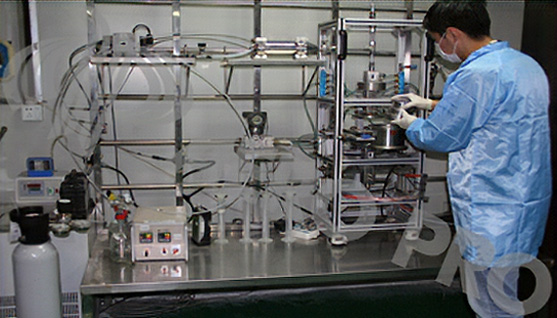
ASHRAE STD 145.1
ASHRAE STD 145.1 is for testing media in a “test tube” apparatus. The depth, diameter and volume of media is constant. This test chamber is then exposed to certain inlet gases with the outlet gas(es) measured. This standard can be used to compare the performance of granular media, but the test must specify the challenge gas or gases to be tested. As such, it is often very application-specific, and due to expense, the manufacturer of any particular granular media may not have a 145.1 test for any particular challenge gas. Further, it is once removed from an actual application, since the testing of media is in a test cylinder.
A 145.1 test may be applicable for comparing and choosing media, but keep in mind one “ASHRAE Standard 145.1” test cannot be compared to another unless the challenge gases are the same. Unfortunately, there is no mixture of gases in the scope of 145.1 that represents typical urban pollution levels. The Standard 145.1 can be quite useful when comparing the performance of various granular media for specific challenge gases, but only when the specific challenge gases are known. And, only when the specific media has been tested for your specific gases.
ASHRAE STD 145.2
This standard can be used to compare the performance of Gas Phase Air Filter assemblies, using a test rig similar to that used in Standard 52.2 for particulate filters. The following diagram is the 145.2 test rig from the Standard.
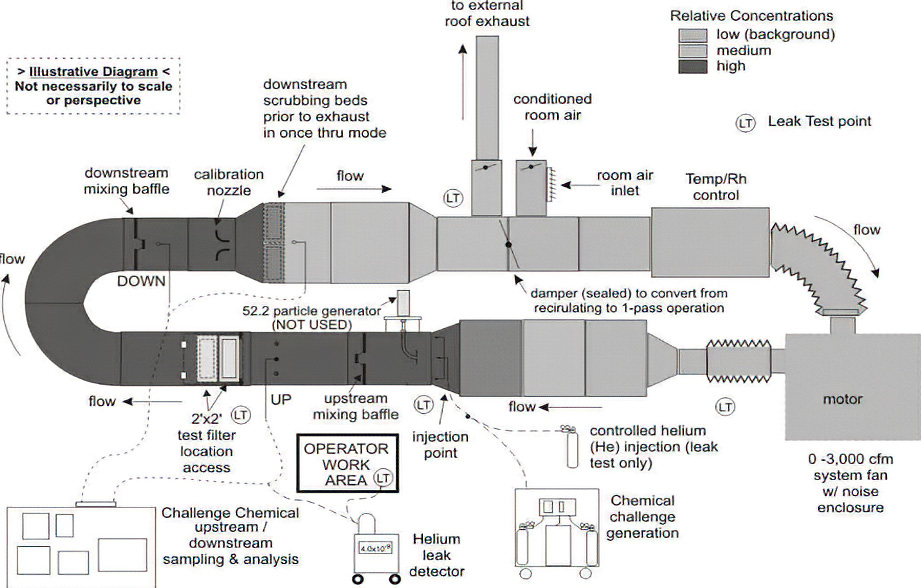
The Standard specifies the calibration and operation of the test. But like 145.1, the 145.2 test must specify the challenge gas or gases to be tested. Moreover, when a filter is tested, the gases to be tested have to include the “required compound” reference gas that is tabulated in the Standard as shown as in the table below.
|
Category / Chemical |
CAS # | MW |
Low Conc. (ppb) |
High Conc. (ppm) |
NIOSH REL TWA (ppm)* |
OSHA PEL TWA (ppm)* |
High Conc. Rationale** |
Capacity Used*** |
Required Compound |
| Acid Gases | |||||||||
| Sulfur Dioxide | 7446-09-5 | 64.1 | 50 | 35 | 2 | 5 | AA |
6%, x 8%, yb |
☑ |
|
Hydrogen Chloride |
7647-01-0 | 36.5 | 75 | 5 | 5 (c) | 5 (c) | DD | 12%, yb | |
| Hydrogen Sulfide | 7783-06-4 | 34.1 | 100 | 25 | 10 (c) | 20 (c) | CC |
12%, x 20%, yb |
|
| NO2+ | 10102-44-0 | 46.0 | 50 | 30 | 1 (st) | 5 (c) | AA |
6%, z 20%, x |
|
| Aldehydes | |||||||||
| Formaldehyde | 50-00-0 | 30.0 | 100 | 1 | 0.016 | 0.75 | EE | 3%, x | ☑ |
| Acetaldehyde | 75-07-0 | 44.1 | 100 | 15 | none | 200 | AA | 10%, x | |
| Hexanal | 66-25-1 | 100.2 | 100 | none | none | ||||
| Basic Gases | |||||||||
| Ammonia | 7664-41-7 | 17.0 | 100 | 75 | 25 | 50 | AA | 5%, ya | ☑ |
| Methylpyrrolidone | 872-50-4 | 99.13 | 100 | 5 | none | none | AA |
15%, xya |
|
| Oxidizing Gases | |||||||||
| Ozone | 10028-15-6 | 48.0 | 75 | 0.5 | 0.1 (c) | 0.1 | BB | none | ☑ |
|
Category / Chemical |
CAS # | MW |
Low Conc. (ppb) |
High Conc. (ppm) |
NIOSH REL TWA (ppm)* |
OSHA PEL TWA (ppm)* |
High Conc. Rationale** |
Capacity Used*** |
Required Compound |
| VOCs | |||||||||
| Toluene | 108-88-3 | 92.1 | 400 | 50 | 100 | 200 | AA | 20%, z | ☑ |
| 2-Butanone | 78-93-3 | 72.1 | 400 | 65 | 200 | 200 | AA | 20%, z | |
| Acetone | 67-64-1 | 58.1 | 400 | 20 | 250 | 1,000 | AA | 5%, z | |
| Benzene | 71-43-2 | 78.1 | 400 | 60 | 0.1 | 1 | AA | 20%, z | |
| Cyclohexane | 110-82-7 | 84.2 | 400 | 55 | 300 | 300 | AA | 20%, z | |
| Cyclopentane | 287-92-3 | 70.2 | 400 | 50 | 600 | none | AA | 15%, z | |
| Dichloromethane | 75-09-2 | 84.9 | 400 | 50 | none | 25 | AA | 20%, z | |
| Ethanol | 64-17-5 | 46.1 | 400 | 50 | 1,000 | 1,000 | AA | 10%, z | |
| Hexane | 110-54-3 | 86.2 | 400 | 25 | 50 | 500 | AA | 10%, z | |
| iso-Butanol | 78-83-1 | 74.1 | 400 | 45 | 50 | 100 | AA | 15%, z | |
| Isopropanol | 67-63-0 | 60.1 | 400 | 35 | 400 | 400 | AA | 10%, z | |
| MEK | 78-93-3 | 72.1 | 400 | 30 | 200 | 200 | AA | 10%, z | |
| Tetrachloroethene | 127-18-4 | 165.8 | 400 | 25 | none | 100 | AA | 20%, z | |
|
m-Xylene o-Xylene p-Xylene |
108-38-3 95-47-6 106-42-3 |
106.2 | 400 | 45 | 100 | 100 | AA | 20%, z | |
| Warfare | |||||||||
| DMMP | 756-79-6 | 124.1 | 75 | 20 | none | none | ☑ | ||
| Miscellaneous | |||||||||
| Chlorine | 7782-50-5 | 70.9 | 100 | 30 | 0.5 (c) | 1 (c) | AA |
10%, z 12%, yb |
none |
The Standard specifies the calibration and operation of the test. But like 145.1, the 145.2 test must specify the challenge gas or gases to be tested. Moreover, when a filter is tested, the gases to be tested have to include the “required compound” reference gas that is tabulated in the Standard as shown as in the table below.