ISO 16890 – Testing Machine
The ISO 16890 is the latest standard for air filter testing and classification with a global coverage and outlook. The new standard was introduced on January 1st 2017 and actively replaced EN 779 in 2018. It brings in a significant harmonization between the two tests standards of ASHRAE 52.2 (USA) and EN 779 (Europe). The advantage of ISO 16890 is that filter efficiency is determined realistically using the four dust categories PM1, PM2.5, PM10 and ISO coarse dust. The ISO 16890 standard uses the same evaluation parameters as the World Health Organization (WHO) and other environmental authorities. This makes the selection of the best possible filters for individual requirements much easier.
Our bodies have built-in defenses to protect against particulate matter larger than 10 μm. Below this, it’s the job of filters to provide protection against the particles our bodies can’t stop.
That’s why the new ISO 16890 standard focuses on a filter’s ability to capture particulate around or below 10 μm. It classifies a filter dependent on its ability to capture coarse dust (particulate larger than 10 μm), PM10, PM2.5 and PM1. And these make up the four filter groups under the new standard.
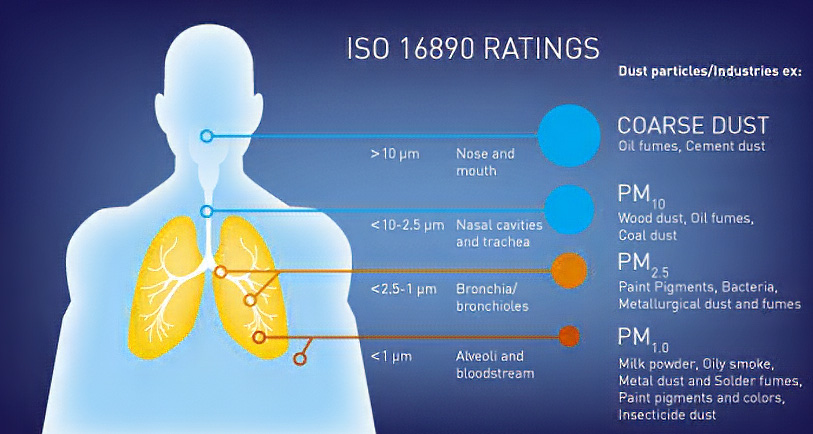
What does PM1 mean?
PM stands for Atmospheric Particulate Matter; the number 1 signifies that the particle range is for one micron diameter particles and smaller. In terms of quantity this is by far the largest particle range within the atmosphere. PM2.5 is the range that covers particles with a diameter of 2.5 Microns and less and finally PM10 particles 10 microns and below.
Test Principle based on ISO 16890: 2018
The new standard specifies two test phases for evaluation of HVAC air filter performance. In Phase 1 of the testing, the pressure drop across the filter is determined as a function of volumetric air throughput. Then the filter's Initial fractional Efficiency is determined over a particle size spectrum of 0.3 μm - 10 μm (12 particle sizes). Two different test aerosols are used in the testing: DEHS (di-ethylhexyl sebacate) aerosol for particulate sizes up to 1 μm and, for larger particulate sizes from 1 μm - 10 μm, KCl (potassium chloride) aerosol.
In Phase 2 of the testing concentrates on the filter's performance by discharging electrostatic charge. Therefore, in Phase 2 the filter is electrostatically discharged in a treatment chamber before its fractional Efficiency and pressure drop are again determined under more realistic conditions.
The results of both test phases are then averaged, providing the average efficiency for each of the fractions PM1, PM2.5 and PM10. Since the IPA conditioning is expected to overpredict the loss in efficiency in real use for charged filters, the average of the two values in each size range is then calculated as representative of the filter’s efficiency in use. Before the filter is classified in an ISO Filter Group, its efficiency results are weighted using theoretical particle size distributions for urban and rural air (In ISO 16890 the amount of particulate matter a filter will be exposed to in situ is represented by two different particle size distributions (psd) called rural and urban. The rural psd is used for calculating the mass removal efficiency for the ePM10 rated filters while the urban psd is used for the ePM2.5 and ePM1 rated filters). The ISO Filter Group classification is done in accordance with these weighted efficiency results.
In the case of ISO Coarse filters, testing of dust holding capacity is mandatory as stipulated by ISO 16890. For all other Filter Groups this is an optional determination. The testing particulate specified for use in the dust arrestance test is ISO Fine Dust.
For eg: an air filter qualifies for Filter Group ISO ePM1 or ISO ePM2,5 if it achieves a minimum efficiency of 50% or greater for particulate sizes ≤1 μm or ≤2.5 μm. Along with the Filter Group achieved, the complete ISO 16890 classification also includes the filter's average efficiency. Minimum efficiency is defined as the efficiency achieved following electrostatic discharge of the filter before testing. Average efficiency is calculated by averaging the filter's efficiencies in the untreated state, i.e., before discharging, and in the discharged state.
For example: if a filter achieves a minimum discharged efficiency of 45% in the PM1 size spectrum and 56% in the PM2.5 size spectrum, it does not qualify for the ISO ePM1 Filter Group – having missed out by 5 % – but does qualify for the ISO ePM2,5 Filter Group. Assuming that the average efficiency achieved by this filter for ISO ePM2,5 particulates was 68%, this percentage is rounded down to the nearest 5% increment (i.e., rounded down to 65 %) and the filter’s ISO 16890 classification is therefore ISO ePM2,5 65%. To be classified in Filter Group, ISO ePM10 a filter must achieve an Initial efficiency of ePM10 ≥ 50 %. There is no discharge efficiency test required for ISO ePM10 Filter. Filters with an initial efficiency <50% for this particle size range are classified in the Filter Group ISO Coarse and according their initial gravimetric arrestance.
Although the efficiency tests in ISO 16890 are performed very similarly to those of ANSI/ASHRAE 52.2, the reported values (ePM vs MERV) do not report the same thing. ISO is a mass-based result and MERV is directly related to individual particle size removal. Health effects of particulate matter (PM) vary based on the particle size. Across various organizations, including U.S. Environmental Protection Agency (EPA), the World Health Organization (WHO) and the European Union PM10, PM2.5 and PM1 are considered important size fractions. Use of the various levels of ePM gives the user a measure of how much of the PM in air will be removed by a filter.
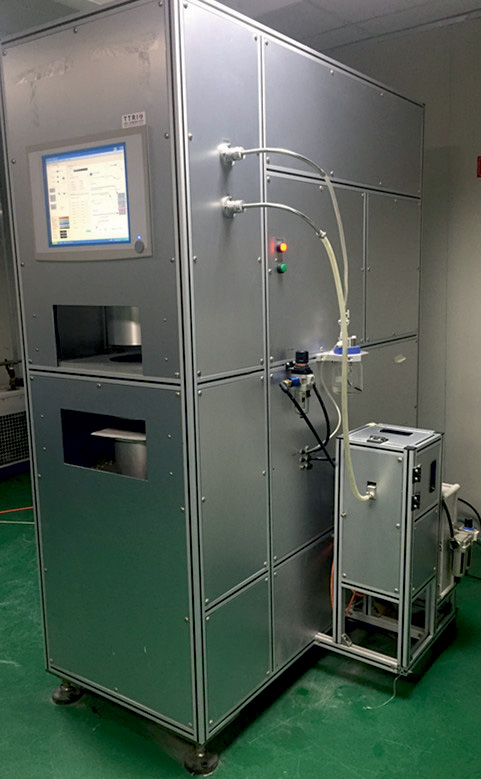
ISO 16890- Automated Testing Machine
Major Benefits of ISO 16890?
The new standard offers several improvements when compared to the previous Standards:-
- It provides an international standard that can be recognized across the globe combining EN & ASHRAE
- The EN779 test qualified fine filter performance at 0.45 microns efficiency whereas ISO 16890 records their performance at a particle spectrum of 0.3 to 10 Microns closely related to WHO norms and hence closely related to IAQ norms and human health.
- Filters can be chosen for their specific need closely related to the application.
- The new ISO standard is more realistic to real life performance of a filter.
- It will be easier to compare products from different parts of the world which can drive innovation and customer value.
| ISO16890: Overview of Classification System | ||||
| Group Designation | Requirement | Class Reporting Value | ||
| ePM1, min | ePM2.5, min | ePM10 | ||
| ISO Coarse | ~ | ~ | <50% |
Initial Gravimetric Arrestance |
| ISO ePM10 | ~ | ~ | >/=50% | ePM10 |
| ISO ePM2.5 | ~ | >/=50% | ~ | ePM2.5 |
| ISO ePM1 | >/=50% | ~ | ~ | ePM1 |
| ISO16890: Classification Table | ||||
| PM | PM1 Classification | PM2.5 Classification | PM10 Classification | Coarse |
| ePM1 95% | ePM2.5 95% | ePM10 95% |
Arrestance reported in 5% |
|
| ePM1 90% | ePM2.5 90% | ePM10 90% | ||
| ePM1 85% | ePM2.5 85% | ePM10 85% | ||
| ePM1 80% | ePM2.5 80% | ePM10 80% | ||
| ePM1 75% | ePM2.5 75% | ePM10 75% | ||
| ePM1 70% | ePM2.5 70% | ePM10 70% | ||
| ePM1 65% | ePM2.5 65% | ePM10 65% | ||
| ePM1 60% | ePM2.5 60% | ePM10 60% | ||
| ePM1 55% | ePM2.5 55% | ePM10 55% | ||
| ePM1 50% | ePM2.5 50% | ePM10 50% | ||
| Particle Size | 0.3-1 Micron | 0.3-3 Micron | 0.3-10 Micron | |
| Requirement |
>50% initial efficiency >50% discharged efficiency |
>50% initial efficiency >50% discharged efficiency |
>50% initial efficiency No discharge requirement |
No discharge requirement |
Note: ISO16890 demands a minimum (discharged efficiency) of 50% for ePM1 and ePM2.5 rated filters.